
Building Blocks: Amethyst Geode
Published: October 20, 2025 - View official source
There are a lot of exciting things to find when you’re digging around below the surface of Minecraft’s Overworld. You might find coal, copper, redstone, diamonds, lava lakes, dripstone caves, mineshafts, or even the terrifying deep dark. But there’s one extra-special feature that you’ll happen across from time to time while mining – one geological oddity that’ll quicken your pulse without exception. It’s the amethyst geode, and it’s our structure of the month.
Okay, perhaps we’re stretching the definition of “structure” here. Geodes aren’t constructed exactly, in the same way that a mountain isn’t constructed – instead they’re the result of zillions of years of geological activity and/or a bunch of complicated computer code (depending on your personal belief system).
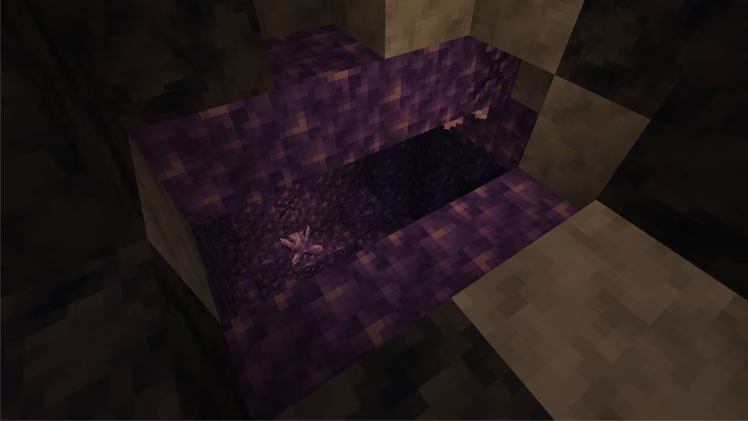
The first sign that you’re encountering an amethyst geode is a wall of smooth black basalt, with a layer of white calcite underneath. Break on through to the other side, as Jim Morrison once suggested, and you’ll suddenly find yourself in a cave of purple amethyst blocks, with shards of amethyst growing out of the sides. Some will appear cracked – these are budding amethyst blocks, which are extremely fragile but can grow new crystals over time.
I don’t have a lot of great advice to those of you looking for a shortcut to find one of these natural wonders. They generate in a layer between Y-levels -58 and +30, and there’s about a one in 24 chance that a given chunk contains one. So they’re rare, but not that rare. You’ll sometimes see one sticking out of the wall of a cave or a canyon. Really, it’s best to just focus on mining and count yourself lucky when you do eventually run into one.
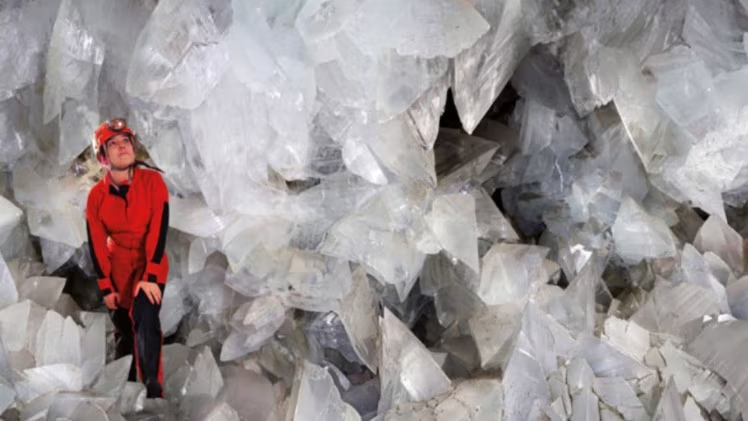

Geodes are very much a thing in the real world too - though they’re rarely as big as those in Minecraft. They form in volcanic or sedimentary environments, when holes in the rock are filled up with water that has minerals dissolved in it. Over long periods of time, these minerals grow into crystals. Exactly what crystals you get depends on the geology of the area - large ones containing amethyst are most common in the Paraná and Etendeka traps region of Brazil and Uruguay.
Generally the resulting geodes are centimetres across, occasionally a bit bigger. But there are a handful of places in the world where enormous caves filled with crystals exist – the Crystal Cave in Ohio, the Cave of the Crystals in Mexico, and the Pulpí Geode in Spain (pictured above) are a few notable examples.
Have you ever thought of naming the places you discover in Minecraft? Next time you go exploring, bring some signs with you - and when you find an impressive mountain, a vast canyon, or – yes – an amethyst geode then write a name on a sign and stick it down on the ground. Then, at the very least, anyone who comes after you will know that you were there first.