
Block of the Week: Hyphae
Published: June 30, 2022 - View official source
The Sun is a magical thing. It powers all of Minecraft’s plantlife. But there’s no Sun in the Nether, and that means there are no plants either. Instead, you’ll find an array of fungal organisms like shroomlights, netherwart, and huge fungus – which produce our block of the week: hyphae.
Switch off your brain while I talk about terminology for a moment. Hyphae is actually a plural, and the singular is hypha, which refers to the long branching, filamentous structures that make up some fungi. Collectively, hyphae are usually called mycelium. But we already had mycelium in the game. So we called these blocks hyphae instead.
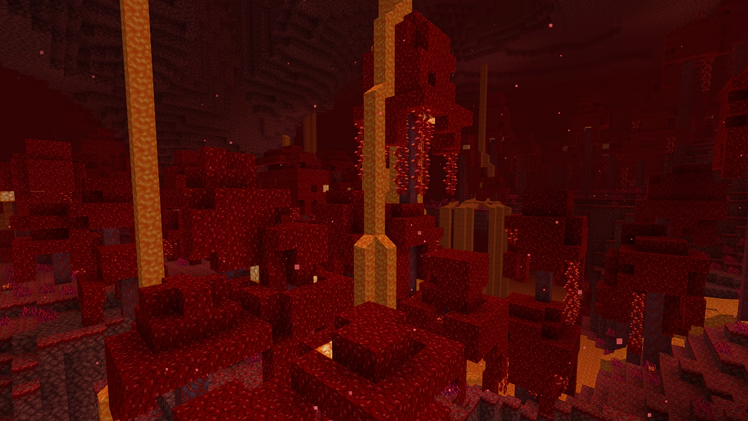
Hyphae appeared in Minecraft in the Nether Update in 2020 – which completely overhauled the Nether, turning it from a wasteland into... slightly less of a wasteland!
There are two variants of hyphae – crimson and warped, which you’ll find in the crimson and warped forest biomes respectively. Chop down a huge mushroom and you’ll get stems - then you can convert that into hyphae by crafting four stems together, just like turning logs into wood. You’ll get three hyphae out.
Hyphae serves as an equivalent to wood – and can be used in place of it in most recipes, with the exception that it doesn’t catch fire. This means that you also can’t use it as a fuel in furnaces. Like wood, you can turn it into planks by putting it into a crafting grid, and you can also use an axe on it to turn it into the “stripped” variant, removing the bark.
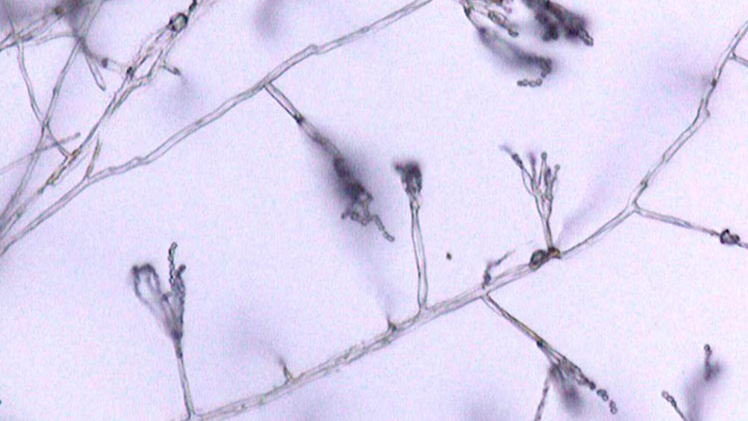
Image credit: Y_tambe // CC BY-SA 3.0

In the real world, hyphae grow as a part of a larger fungus too. Each hypha is about 10 micrometers in width, which is about the same as a strand of spider web silk, and about a tenth as wide as a human hair. They grow from the tip, and often form huge networks below the surface of forests, transferring water and nutrients, which are sometimes known as the “wood wide web”.
We’re only beginning to understand how important these networks are to the natural world. A forest with a strong network of hyphae grows faster and is more resilient to pests and other damage. There are even some species of plant that can’t get energy from the sun, and rely instead on hyphae to deliver the nutrients they need.
Some researchers even suggest that plants can communicate in a limited way between each other over these networks. They point to experiments showing plants releasing defensive chemicals when a nearby plant is under attack, or sharing water and other nutrients in drought conditions.
We need to do more research to figure out whether this is true “communication” or just a response to a signal. But that’ll take a while, so go play some Minecraft and then check in again on the science in a few years time.