
Taking Inventory: Lapis Lazuli Ore
Published: February 12, 2026 - View official source
We’ve all been there – deep in a mining expedition, with your inventory filling up with cobblestone, and your hunger bar emptying rapidly. You mine a block – nothing behind it. You mine a block – nothing behind it again. You consider going up to the surface to resupply. No – one more block. You mine it. Wait – omg, is that diamond ore? Oh. No. It’s our block of the week – lapis lazuli ore.
While lapis ore might not be quite as exciting as diamonds, it’s still pretty useful. It’s one of the few ways to get hold of lapis lazuli which, as we’ve previously discussed, is used for decorative purposes and in the enchantment process. Mining a block will drop four to nine lapis lazuli, but this can be boosted with the Fortune enchantment, giving a single block a chance to yield a whopping 36 lapis.
Finding lapis lazuli ore is not always easy, but it’s easier today than it was when it was first launched – in the Beta 1.2 patch in January 2011, alongside cake, dispensers, and bones. On release, each block of ore dropped just one item. That was swiftly changed after a player named elt complained that it was more practical to build a solid diamond house than a lapis one.
To optimize your lapis collection efforts, you’re going to want to head down to the stone-deepslate boundary. I’m not sure why, but that’s where you’ve got the highest chance of finding the stuff. Perhaps it’s something to do with the geological processes where the stone meets the deepslate? Either way, in that zone there should be about 14 blocks of lapis lazuli ore (both the stone and deepslate types) for every 10,000 other blocks. Not great odds, admittedly, but the best you’ll get.
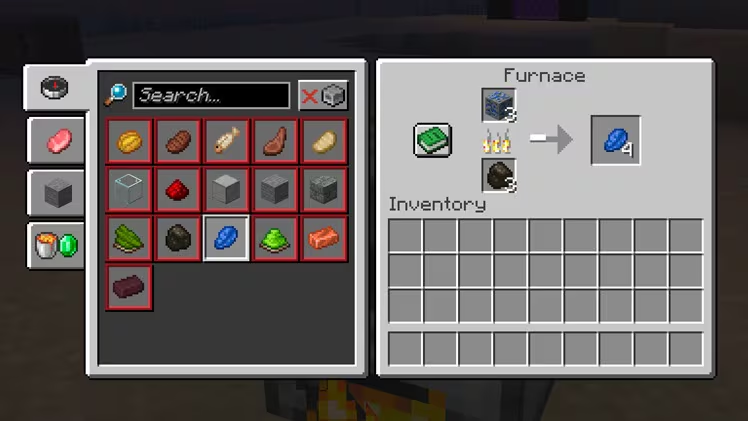
Once found, you can simply break the ore with your pickaxe to get at the raw lapis lazuli. But you can also use a silk touch enchanted pick if you want to get the ore block itself. If you accidentally mine it as an ore block but you want the item, then that’s easy to fix – either place it in the world and mine it again, or pop it in a furnace.
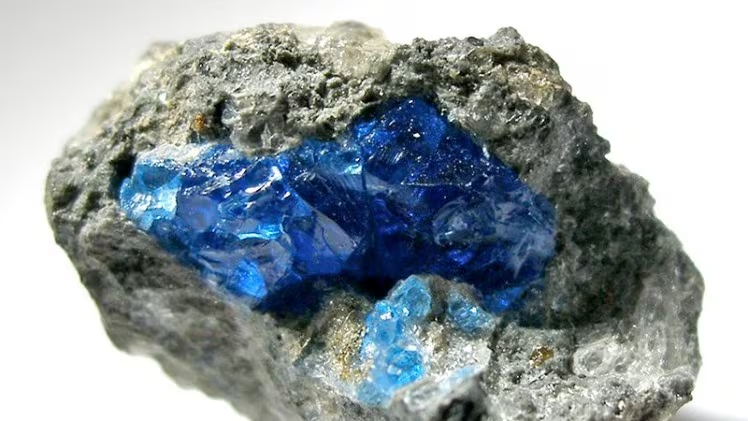
Image credit: Rob Lavinsky, iRocks.com // CC BY-SA 3.0

There are a bunch of real-world minerals with similar names that would probably qualify for being named as the official equivalent of Minecraft’s lapis lazuli ore. They include lazurite, azurite, lazulite and hauyne – all of which have been known in the past as azure spar. The blue color in these mostly comes from sulfur ions – and if you’re wondering why yellow sulfur creates a blue color in rocks, then I’m sure your chemistry teacher will be very excited to explain.
That blueness of lapis has made the ore valuable since prehistoric times. It was originally mined in what is now northeastern Afghanistan, but beads made out of lapis lazuli spread all across the world – from the Caucasus mountains to Mauritania in western Africa. It was even used in the funeral mask of Tutankhamun, who died around 1323 BC. Later, it was used to make blue pigment by medieval Europeans – including by Vermeer, who used it to paint his work Girl with a Pearl Earring.
The mines in Afghanistan are still a major source of lapis lazuli today, but it’s also found around Laika Baikal in Russia, in the Andes mountains in Chile, and occasionally in Pakistan, Italy, Mongolia, the US, and Canada. I bet you’ll find it in your Minecraft world too – if you dig long enough. One more block...