
The Father of the Video Game Cartridge
Published: February 15, 2022 - View official source
Looking back through the history of video games is always a wild experience. Did you know that Lara Croft’s first in-game model only had 230 polygons? For reference, nowadays player characters can easily exceed 30,000 – not that polygons should be a measure of beauty! Technically, the Enderman is a collection of rectangular blocks and yet it still managed to infiltrate my nightmares.
Obviously, this exponential technical progress was only possible thanks to a lot of hard work and talent – and one person that brought a significant contribution to the gaming industry was Gerald Anderson Lawson, also known as Jerry Lawson. He was an American electronic engineer who pioneered some literally game-changing innovations.
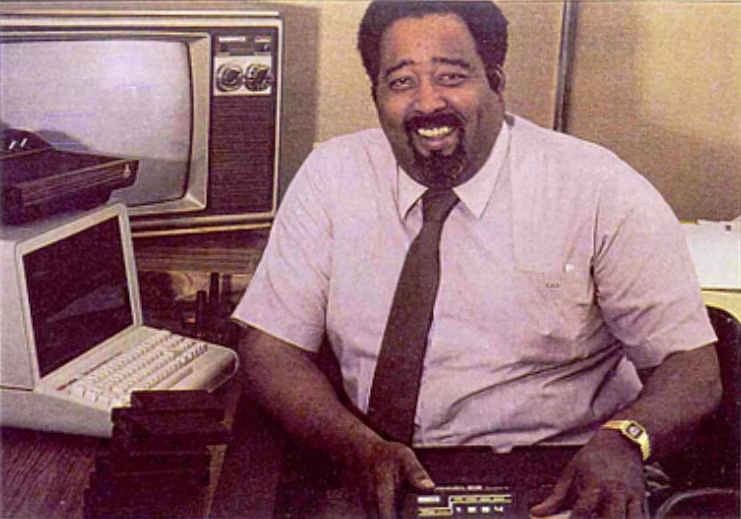
Image source: Wikipedia*

Born on December 1, 1940, Jerry Lawson had always been interested in science and technology, especially ham radio and chemistry. As a teenager, he earned money by repairing TVs and then bought parts to build his own ham radio station at home. Early in his career, he joined Fairchild Semiconductor and created a coin-operated arcade called Demolition Derby game using their F8 microprocessor – whereas I needed two separate crash courses just to understand the control panel on our Dungeons Arcade. Demolition Derby was actually one of the earliest microprocessor-driven game systems.
In the mid-1970s, after being promoted to Chief Hardware Engineer and Director of Engineering and Marketing of Fairchild's video game division, he led the development of the Fairchild Channel F console. Released in 1976, the Channel F was very special because unlike most game systems at the time, it used swappable game cartridges, based on technology licensed from a company called Alpex, which Lawson’s team then refined. Most consoles at the time had the game programming built into their hardware, which meant that you were stuck with whatever games it came with. Pretty crazy to think about it in the age of digital downloads and game subscription services like Game Pass, PS Now, or Taking My Sibling's Device While They Sleep.
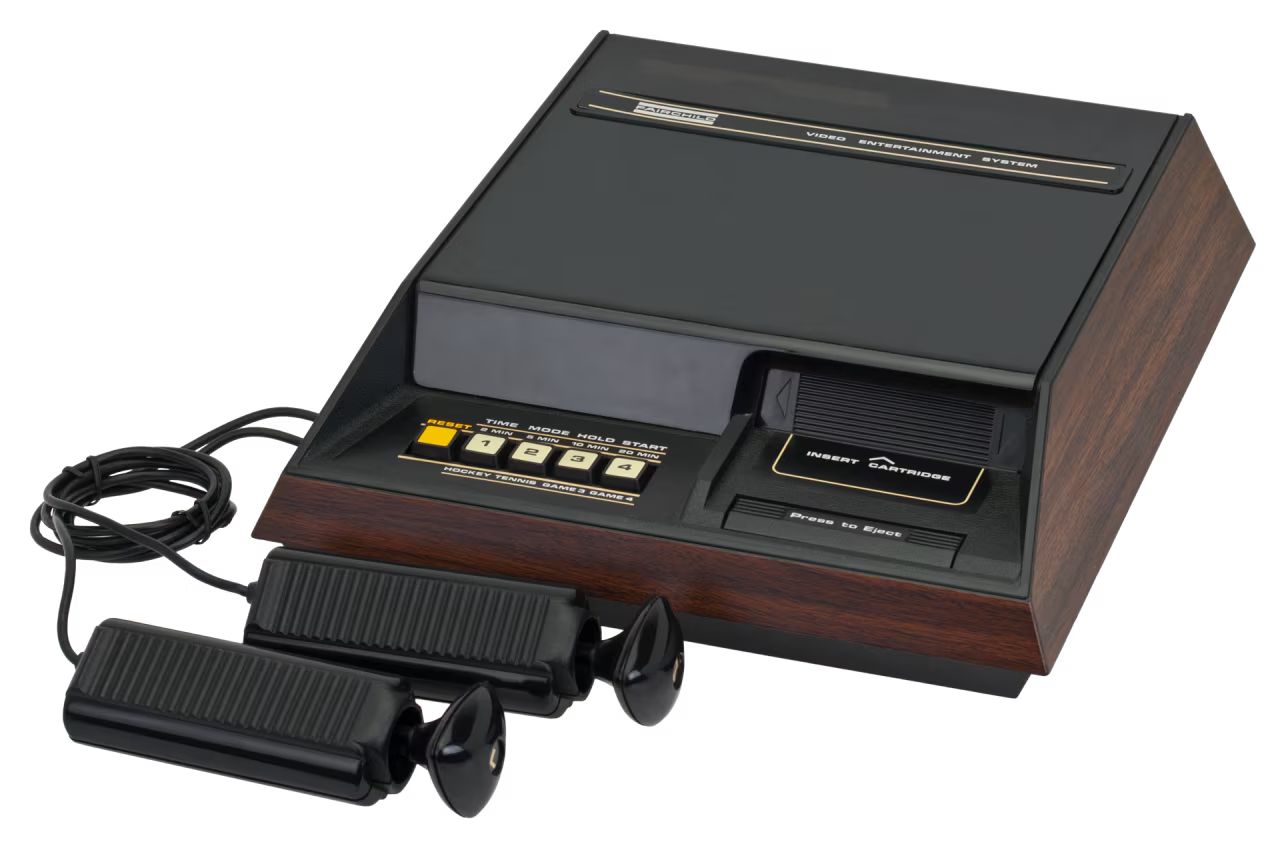
The Fairchild Channel F allowed players to build their own game library, while also creating a new source of income for companies, enabling them to not only sell the consoles themselves but also a variety of games. For this device, Jerry Lawson also designed a new 8-way joystick, as well as a first for home video consoles: a dedicated pause button, which is something I’m extra appreciative of as an easily overwhelmed gamer. I couldn’t imagine not being able to pause whenever I hear the hissing of an approaching creeper – not that it’s much help, but it gives me the illusion of safety.
Sadly, despite its many innovations, the Fairchild Channel F was not commercially successful. Cartridge-based systems were later popularized by the Atari 2600, which was released in 1977 and displaced it as the top console on the market. Jerry Lawson moved on to found Videosoft in 1980, a company that made software for the Atari 2600. Around five years later, he closed the company and started consulting work, and later even collaborated with the Stanford mentor program.
Jerry Lawson’s work in pioneering the commercial video game cartridge did receive some recognition, although a lot of it only came in relatively recent years. In 1982, Black Enterprise magazine dubbed him "father of the videogame cartridge". In 2011, he was honored as an industry pioneer for his work on the same concept by the International Game Developers Association. And in 2019, he received the ID@Xbox Gaming Heroes award at the 21st Independent Games Festival. If you’re passing through or live in Rochester, New York, you can also visit the permanent display of Jerry Lawson’s contribution to the video game industry at The World Video Game Hall of Fame at The Strong National Museum of Play.
Jerry Lawson passed away in April 2011, but his work changed the video game industry forever, starting from before many of us were even born, let alone played Minecraft. If you’re interested in learning more, he was also featured in quite a few documentaries in recent years.
Of course, there are many examples of Black excellence in gaming that have gone unrecognized in the past decades. During Black History Month and beyond, let’s try to learn about even more Black figures that advanced the gaming industry, and take a moment to appreciate their legacy.
*Image by Unknown, but currently held by Museum of Play / Estate of Jerry Lawson - Original publication: Hilliard, S. Lee (December 1982). "Cash in on the Videogame Craze: Career opportunities are wide open in this booming multi-billion dollar industry". Black Enterprise. Vol. 12, no. 5. Earl G. Graves, Ltd. pp. 41–6. ISSN 0006-4165. Immediate source.